¶ Home Worlds
When you join an arena you pick a home world: a size and a type. That single choice follows you for the rest of the game. Every planet you ever settle or conquer is scored against your home world, and the result decides its food, production, science, ore, and loyalty.
Your capital is created to match your pick exactly. It is named <your nickname> Prime, and it starts with 5 population, 100 loyalty, and a 35 scan range. On the default 34/33/33 job split those five citizens come out as 2 farmers, 2 workers and 1 scientist. It also has a moon, something only home worlds and the Ferion planet have. The moon can carry its own buildings and, late in the game, be launched at an enemy planet. See Moons.
[toc]
¶ The six types
Six planet types occur naturally in the galaxy. Each is generated with equal probability, so roughly 1 in 6 of all planets is any given type.
 Lava |
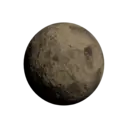 Desert |
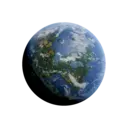 Temperate |
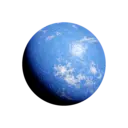 Oceanic |
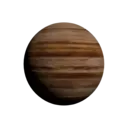 Gas Giant |
 Ice Giant |
Three further types exist but cannot be chosen as a home world, and are never generated naturally:
 Ferion |
 Ringworld |
Destroyed |
| The single legendary world. Doubles food, production and science, and sits at 100 loyalty for whoever holds it. | Built, not found. See Megastructures. No population cap and a 6x production multiplier. | The remains of a bombed-out world. Cannot be settled. |
¶ The three sizes
| Size | Share of the galaxy | Also called |
|---|---|---|
| Small | ~24% | Low gravity |
| Medium | ~51% | Medium gravity |
| Large | ~25% | High gravity |
The game talks about planet size as gravity. A large planet is a high-gravity world, a small planet is a low-gravity one. Your species is adapted to the gravity of its home world, and works badly on worlds far away from it.
¶ The two axes
Every planet you own is compared to your home world on two independent axes: gravity (size) and type. Each axis is worth plus or minus 50% of the planet's base workforce output, and the two are simply added together.
They apply to all three worker outputs:
 Food, which drives population growth
 Production
 Science
¶ Gravity (size)
| Your home world | Small planet | Medium planet | Large planet |
|---|---|---|---|
| Small | +50% | 0 | −50% (gravity too high) |
| Medium | 0 | +50% | 0 |
| Large | −50% (gravity too low) | 0 | +50% |
The gravity penalty only ever fires on the extremes. Small and Large are opposites of each other; Medium is its own opposite, so a Medium species is never punished by gravity anywhere in the galaxy. It simply gets its bonus on the most common size and nothing on the other two.
¶ Type
| Planet type vs. your home world | Modifier |
|---|---|
| Same type | +50% |
| Opposite type | −50% |
| Any of the other four | 0 |
¶ Paradise and toxic worlds
When both axes line up you get a Paradise, and when both go against you, you get a Toxic world. These are the two extremes of the five compatibility grades shown throughout the interface.
| Grade | Name | Meaning | Total workforce modifier |
|---|---|---|---|
| A | Paradise | Type and size both match your home world | +100% |
| B | Good | One axis matches, neither is opposite | +50% |
| C | Average | Everything else | varies |
| D | Poor | One axis is opposite, neither matches | −50% |
| E | Toxic | Type and size are both opposite | −100% |
A Paradise world doubles what its workers produce. A Toxic world cancels its workforce output out completely: whatever your farmers, workers and scientists would have made, the penalty removes all of it before any tax, Ferion or Ringworld multiplier is applied.
Ringworlds always count as grade A regardless of your species.
Careful with grade C. The compatibility grade is a summary of the two workforce axes only. It does not know about ore. A planet of your opposite type but a matching size still shows as a C, yet it mines nothing at all (see below). Read the planet's type, not just its letter.
¶ Your opposite type
Every type has exactly one opposite. This is the single most important thing to know about your home world, because the opposite type is what makes a world toxic and what kills your ore.
The opposites run in two rings of three, and they turn in one direction only:
Lava → Oceanic → Ice Giant → Lava
Desert → Gas Giant → Temperate → Desert
Read it as "the arrow points at my poison".
| Your home world | Your opposite (toxic) type |
|---|---|
 Lava Lava |
 Oceanic Oceanic |
| Oceanic |
 Ice Giant Ice Giant |
| Ice Giant |
Lava |
 Desert Desert |
 Gas Giant Gas Giant |
| Gas Giant |
 Temperate Temperate |
| Temperate |
Desert |
Opposition is not mutual. If you are Lava, Oceanic is poison to you, but an Oceanic species is not poisoned by Lava: its enemy is Ice Giant. Do not assume that because a rival's home world is toxic to you, yours is toxic to them.
¶ Ore output
Each planet type sits on a fixed pair of ores. Every planet rolls its primary and secondary ore slot independently from its type's pair, and each slot gets a base extraction of 1 to 20 per week.
| Type | Its two ores | Refines into | And then into |
|---|---|---|---|
| Lava |
 Bezantium Bezantium  Radiusant Radiusant |
 Karmasas Karmasas |
 Ferros Nr.6 Ferros Nr.6 |
| Desert |
 Nucloid Nucloid  Verrotan Verrotan |
 Nadzerbat Nadzerbat |
Ferros Nr.6 |
| Temperate |
 Boturkoec Boturkoec  Nagazal Nagazal |
 Galagores Galagores |
 Sjampoo Sjampoo |
| Oceanic |
 Formets Formets  Grindazine Grindazine |
 Miout Miout |
Sjampoo |
| Gas Giant |
 Perunga Perunga  Veronium Veronium |
 Ldwarts Ldwarts |
 Texorrium Texorrium |
| Ice Giant |
 Blazanter Blazanter  Terrilliod Terrilliod |
 Mankazor Mankazor |
Texorrium |
 Ore does not care about your population. Extraction comes from the planet itself plus any mining buildings on it. Workers, farmers, gravity and the type bonus have no effect on it whatsoever. A 1-population world with good mines out-mines a 30-population world with none.
¶ Toxic ore
This is where your opposite type really bites, and it works in two separate ways.
1. An opposite-type planet mines nothing. If a planet is your opposite type, both its primary and secondary extraction are set to zero at the source. It does not matter how large it is, how many mines you build, or how many people live there.
2. Your opposite type's two ores are banned empire-wide. Every week, when ore is collected, the two ores belonging to your opposite type are thrown away, no matter which planet produced them. Even a Paradise world that happens to sit on one of those ores will hand you nothing.
| Your home world | Ore you can never mine | Which locks |
|---|---|---|
| Lava |
Formets Grindazine |
Miout, and so Sjampoo |
| Oceanic |
Blazanter Terrilliod |
Mankazor, and so Texorrium |
| Ice Giant |
Bezantium Radiusant |
Karmasas, and so Ferros Nr.6 |
| Desert |
Perunga Veronium |
Ldwarts, and so Texorrium |
| Gas Giant |
Boturkoec Nagazal |
Galagores, and so Sjampoo |
| Temperate |
Nucloid Verrotan |
Nadzerbat, and so Ferros Nr.6 |
A refinery needs both of an ore's ingredients to work. Because the two ores you are banned from are exactly the two ingredients of one level 2 ore, you can never mine your way to that ore, and therefore never to the level 3 ore built on top of it. Every empire is permanently short of one branch of the ore tree.
That is by design, and it is the engine of the game's economy. To get the branch you are locked out of, you must:
- Trade for it. The ore exchange converts one ore into another for
 credits, and it does not care that the ore is toxic to you. This is the main route.
 - Harvest a nebula. Nebulae yield level 3 ores directly to ships parked in them. See Nebulae.
- Find it in a treasure.
No empire is self-sufficient. Sooner or later everyone has to deal.
¶ Loyalty on settle and conquer
Your home world also sets the starting loyalty of every world you take, whether you settle it or capture it.
| The planet | Starting loyalty |
|---|---|
| A Ferion planet, any owner | 100, already Loyal |
| Type and size both match your home world (a Paradise) | 75 |
| Type and size are both opposite (a Toxic world) | 25 |
| Anything else | 50 |
A high-loyalty planet draws far less from your  authority pool. See Settling & Population.
This makes conquest direction matter. Taking planets from an empire whose home world matches yours is cheap, because their worlds are already the worlds you thrive on. Taking your opposite's worlds is expensive on every axis at once: yields, gravity, loyalty and ore.
¶ Terraforming and Ringworlds
Both of the long-term planet projects are anchored to your home world type.
- Terraforming always converts a planet towards your home world type. There is no choice of target. It consumes your type's level 2 ore, and completes at 25 progress. This is how a toxic world is cured: turn it into a Paradise.
- Ringworlds require every planet in the star system to already be your home world type, all owned by you, with at least 5 planets in the system. Terraforming an entire system to your own type is the price of admission.
¶ What your home world does not affect
To save you guessing:
- Maximum population. Every normal planet caps at 30, whatever its size or type. Large planets do not hold more people. Only Ringworlds are uncapped.
- Whether you can settle a planet. You can settle any unowned, undestroyed planet, however toxic. It will just be miserable.
- Build costs, hit points, defenses or scan range.
Planet size in particular does only two things in the whole game: the gravity modifier, and starting loyalty.
¶ Choosing well
- Medium is the safe pick. Because Medium is its own opposite, a Medium species never suffers a gravity penalty anywhere, and it collects its +50% on the most common size in the galaxy. Small and Large both gain and lose in roughly equal measure.
- Look at what you are giving up, not just what you gain. Every type is equally common, so the +50% side of the type axis is the same for everyone. What actually separates the six choices is the ore branch you are locked out of and who your opposite is.
- Know your poison on day one. The opposite table above is worth memorising. It tells you which planets to never settle, which ore is worthless in your hands, and which neighbour is the expensive one to invade.
This page in other languages: Български: Родни светове · Čeština: Domovské světy · Deutsch: Heimatwelten · Español: Mundos natales · Français: Mondes d'origine · Italiano: Mondi natali · Magyar: Anyabolygók · Nederlands: Thuiswerelden · Polski: Światy macierzyste · Português (Brasil): Mundos Natais · Română: Lumi natale · Русский: Родные миры · Türkçe: Ana Dünyalar · Українська: Рідні світи · 简体中文: 母星 · 한국어: 모성