¶ What is fog of war?
Fog of war means that you can only see on the map what is within your scanning range.
¶ OG Ferion
The original Ferion had a sort of fog of war where you needed to just discover a star system and everything would be known to you, all the time. This was logical to do with the hardware limitations we had back in the day — real fog of war would have been expensive to calculate.
¶ How do I discover?
Using scanners. Planets and ships both have scanners. Planet scanners are usually more powerful and used to detect incoming enemies. Ship scanners allow you to discover enemy fleets, planets, wormholes, and more.
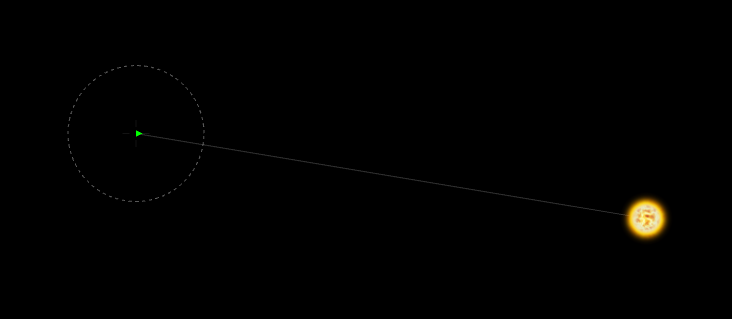
The dotted circles around your ships and planets indicate their scan range
¶ Permanent visibility
From the start of the game you can see all the stars on the map. Planets remain visible on your map after you have discovered them — however, the information about that planet (who owns it, whether it's destroyed, etc) is frozen at the last time you observed it. Other players' ships are only visible if they are within your active scan range.
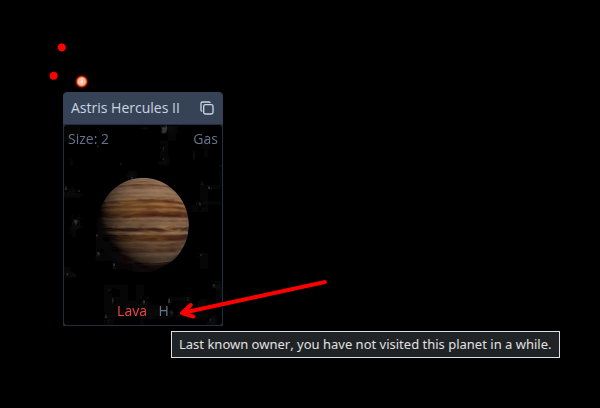
A stale-info marker shows on a planet you haven't observed recently
¶ How to discover planets?
Discovering planets requires a ship with scanners. Usually players fly around the star in a circle to find most of the planets. Once you have one settled planet in a solar system, its scanners will pick up the other planets in most cases.
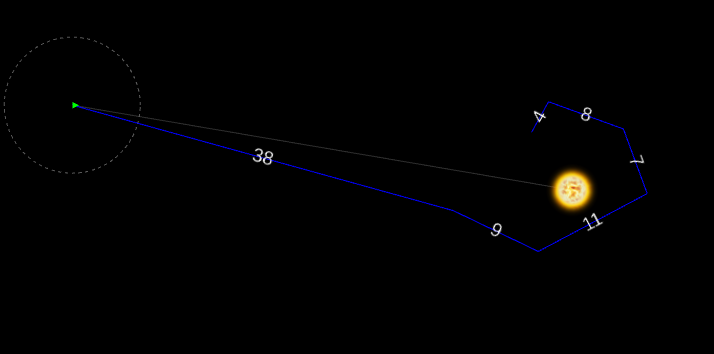
Command your scouts to fly around the star to find the planets
You can also hire Vorn from the Ministry of Exploration. An enigmatic astrophysicist rumoured to hear "stellar whispers," Vorn uses gravitational waves and spectral anomalies to reveal hidden planetary systems. With him in your cabinet, the moment one of your ships reaches a star every planet in that system is revealed at once. (Trait code: discover_star_reveals_all_planets.)

Vorn, Ministry of Exploration
¶ Alliance shared map data
If you're in an alliance, planet visibility is automatically shared between members on every day. A planet your ally has discovered becomes visible on your map too, and the stale-info snapshot they hold is shared as well — so the alliance can coordinate without each member having to re-explore the same systems. Ship positions are not shared the same way: those still need to be in someone's active scan range.
¶ Nebulae and portals
Nebulae are tracked per player: each one only appears on your map once your scanners have discovered it. Portals work the same way — once one of your ships or planets observes a portal, both of its endpoints become known to you.